ServicesWater testing
Water Testing in Carrollton
We test the water at your tap before anyone talks about equipment. You get measured numbers for hardness, chlorine, iron, pH and total dissolved solids, a lab option for lead and other metals, and a written report that explains what each result means for your home.
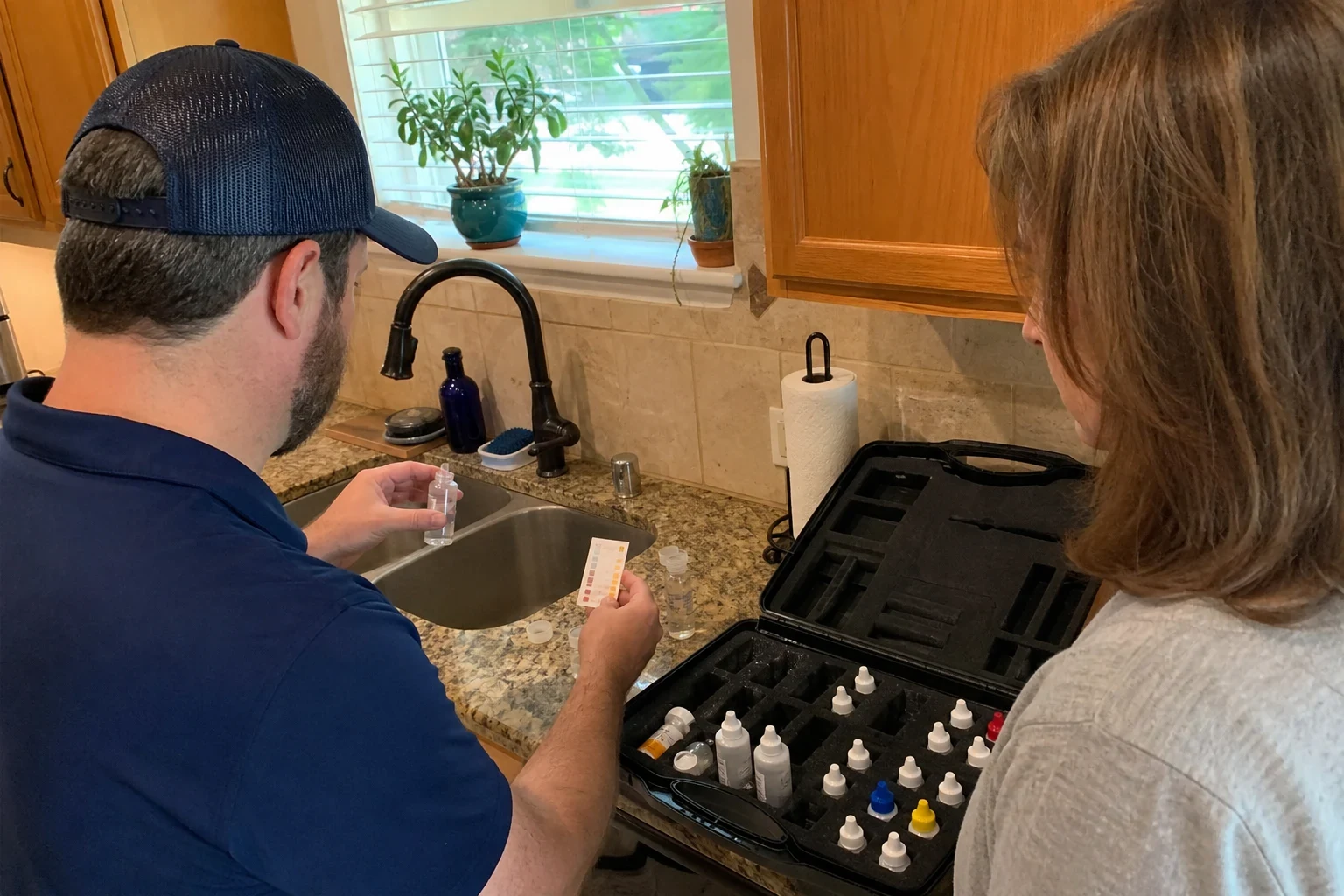
Know what is in your water before you buy anything
Most filtration sales start with a product. Ours start with a measurement. Treated city water leaves the plant meeting federal standards, but what reaches your faucet can change on the way. Old service lines, galvanized steel pipe, brass fittings and a water heater full of sediment all add their own signature. A test tells us which of those is actually happening in your home.
We run quick on-site checks with calibrated meters and reagent strips, then send a sample to an independent lab when the question needs a lab answer, such as lead or a full metals panel. The result decides the next step. Sometimes that is an under-sink reverse osmosis system for drinking water. Sometimes it is a cartridge change. Sometimes the honest answer is that you need nothing at all.
If the test is part of a bigger problem, like staining after a pipe repair or a leak you are discussing with your insurer, the written report and our photos give you a clean record of conditions on the day we tested. We explain what the numbers show; your adjuster decides what the policy covers.
What you get with our water test
Chemistry readings at your faucet
We read hardness in grains per gallon, free and total chlorine, pH, iron and total dissolved solids. Total chlorine is important because many utilities use chloramine, which a simple chlorine strip may not catch.
Samples sent to an independent lab
When you need lead, copper, arsenic or a wider contaminant panel, we take a first-draw sample in a sealed lab bottle and send it to an independent laboratory. Meters cannot detect lead at the levels that count, so we do not estimate it.
A look at fixtures and pipes
We check aerators, shower heads, the water heater drain and any exposed pipe. White crust suggests scale, orange or brown residue suggests iron, and blue-green streaks suggest copper corrosion.
Dated photos
We take dated photos of staining, scale and each sample point. They are handy for your own records and for any insurance discussion already in progress.
A written report in plain words
Each result sits beside the federal limit or the point where it begins causing trouble in a home. We note what it means and what, if anything, we would recommend.
Signs it is time to test your water
Taste or smell has changed
A swimming-pool smell usually means chlorine or chloramine. A sulfur or metallic taste points to something in your plumbing or water heater, and a test separates the two.
Spots, crust or stains
White film on glass shower doors means dissolved minerals. Rust-colored rings in toilets and tubs suggest iron, often from aging steel pipe rather than the supply.
Your home has older plumbing
Homes built before 1986 can have lead solder on copper joints, and some still carry galvanized lines. A first-draw lab sample shows whether metals are reaching your glass.
You were quoted a softener or system
If someone recommended equipment without measuring anything, test first. A hardness number decides whether a softener makes sense in your home.
After plumbing work or a leak
Repairs, repiping or water heater replacement can stir up sediment and loosen scale. Testing afterward confirms the water settled back to normal and gives you a dated record.
What happens during a testing visit
- 1
A quick phone conversation
We ask what you have noticed, how old the house is, and whether anyone at home has a newborn or follows a medical diet. Those answers tell us which tests to bring.
- 2
Drawing samples
Most visits cover the kitchen faucet, an outdoor spigot ahead of any treatment, and the hot side. For a lead test, we ask that the water sit unused for at least six hours so we get a genuine first draw.
- 3
Readings and photos on the spot
Meter and reagent readings are done before we go, and we go over them with you at the sink. Any lab samples are sealed, labeled and shipped.
- 4
Report and next steps in writing
Once the lab returns its results, you receive the full report with our straight read on it. If treatment is called for, we explain which option suits your water and why the others fall short.
What changes the price of a water test
A quick on-site check and a full lab panel are different amounts of work, so the price follows what you need answered. We go over the choices by phone and put the estimate in writing before ordering any lab work.
- How many things we measure
- Reading hardness, chlorine, pH and iron on site costs little. Every lab item, like lead, copper or arsenic, carries its own lab fee.
- Spot checks or a lab panel
- A focused lead test is cheaper than a wide screening panel. We suggest the smallest test that answers your question.
- Number of sample points
- One faucet is quick. Sampling the incoming supply, the water heater outlet and several fixtures takes longer, but it is often the quickest way to pinpoint where your water starts to change.
- A follow-up test after treatment
- When a system goes in, a later test checks that it is working. That is its own, smaller visit.
Questions about water testing
Something not covered here? (972) 430-6272
Doesn't the city already test the water?
It does, at the plant and throughout the distribution system, and it publishes a yearly water quality report. Those numbers describe water before it reaches your house. Your service line, pipes, fixtures and water heater can all change it, and only a sample taken at your tap reveals that.
Will I need a softener?
Maybe, but let the hardness reading decide. We measure it in grains per gallon and tell you whether the scale you are seeing warrants a softener or a simpler fix. Our water softeners page covers how we size one when the test supports it.
When will lab results come back?
You get the on-site readings during the visit. Lab timing depends on the panel and the lab's workload, and we give you the expected wait when we take the sample.
Will your report help with an insurance claim?
It can act as documentation. The report and dated photos record your water conditions and any staining or scale on the test date. We are not your adjuster and do not predict coverage; we hand you clear records and explain what they mean.
Are you going to push a filter on me?
Only when the results call for one. Plenty of tests end with a small fix, such as swapping a worn cartridge through our filter replacement and maintenance service, or with no action needed.
Get real numbers for your water
We serve Carrollton and nearby towns including Coppell, Farmers Branch and Lewisville. Tell us what you have noticed and we will suggest the right test.